Maximum Surface Temperature
Any surface hot enough to ignite a flammable gas or dust becomes an ignition source, no spark required. Controlling maximum surface temperature is therefore fundamental to explosion protection. The ATEX Equipment Directive and IEC 60079-0 establish requirements ensuring equipment surfaces remain below the ignition threshold of surrounding atmospheres.
Why Surface Temperature Matters
When a flammable substance contacts a surface above its auto-ignition temperature (AIT), spontaneous combustion occurs without any electrical spark or flame. Hot motors, lighting fixtures, braking systems, bearings, and process equipment can all present this hazard. The maximum surface temperature, the highest temperature any accessible part can reach under any operating condition, must be controlled.
Temperature Classes for Gases
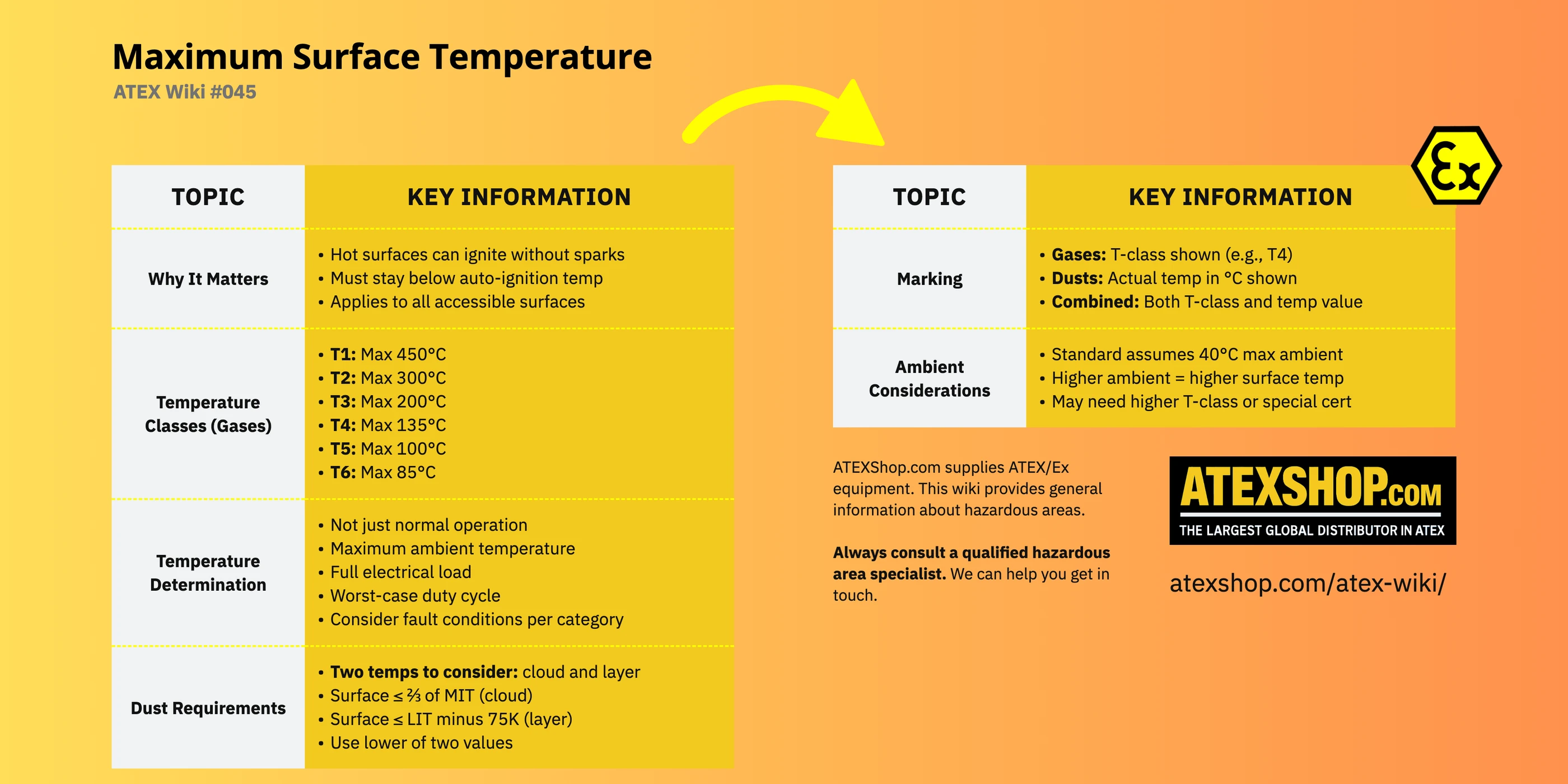
For gas and vapour atmospheres, IEC 60079-0 defines six temperature classes (T-classes) specifying maximum permissible surface temperatures:
- T1: Maximum 450°C
- T2: Maximum 300°C
- T3: Maximum 200°C
- T4: Maximum 135°C
- T5: Maximum 100°C
- T6: Maximum 85°C
Equipment must be rated for a T-class where its maximum surface temperature stays below the AIT of any gas present. A T4-rated motor (max 135°C) is safe for substances with AIT above 135°C, such as methane (AIT 595°C) or propane (AIT 470°C), but not for carbon disulphide (AIT 90°C) which requires T6 equipment.
Temperature Determination
Maximum surface temperature isn't simply measured during normal operation. IEC 60079-0 requires assessment under the most onerous operating conditions, considering: maximum rated ambient temperature, full electrical load, worst-case duty cycle, blocked ventilation or cooling failures (depending on category), and any other conditions the equipment might encounter.
For electrical equipment, temperature rise from current flow, eddy currents, and dielectric losses all contribute. Measurements must cover all accessible surfaces, including any parts that could contact the surrounding atmosphere.
Dust Temperature Requirements
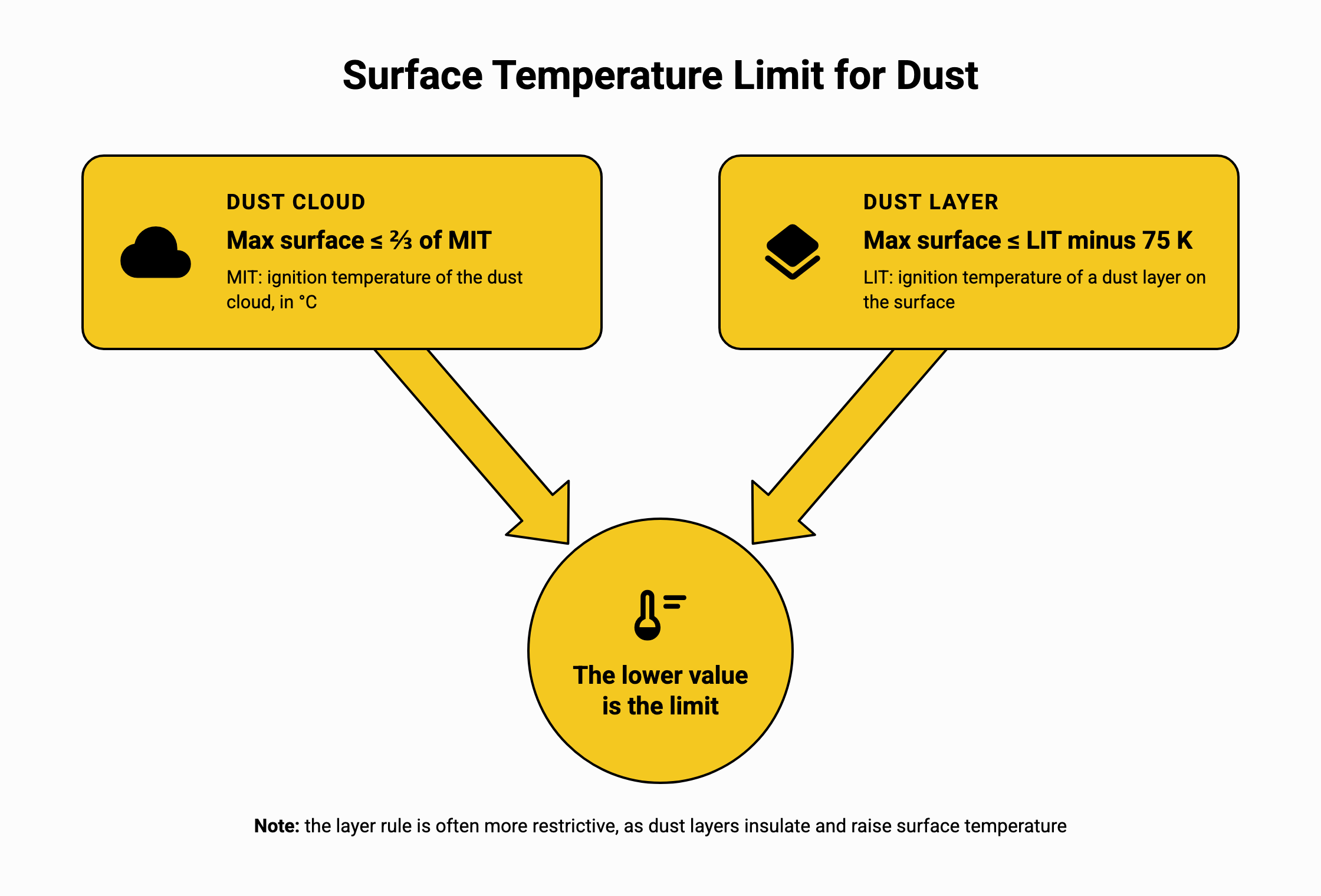
For combustible dust atmospheres, two ignition temperatures apply: the cloud ignition temperature (MIT) and the layer ignition temperature (LIT). Equipment surface temperatures must stay below both thresholds, calculated as:
- Dust cloud: Maximum surface ≤ ⅔ of MIT (in °C)
- Dust layer: Maximum surface ≤ LIT minus 75K
The lower of these two values determines the actual limit. Since dust can accumulate on surfaces, forming insulating layers that increase surface temperature, the layer ignition calculation is often more restrictive.
Marking Requirements
Temperature information appears in ATEX marking. For gases, the T-class is stated (e.g., "T4"). For dusts, the actual maximum surface temperature is marked in degrees Celsius. Combined equipment for both atmospheres shows both: "T4" for gas suitability plus the actual temperature value for dust assessment. The same applies to portable devices: an explosion proof tablet certified for both gas and dust shows a T-class for gas and a maximum surface temperature in °C for dust.
Ambient Temperature Considerations
Standard temperature classes assume a maximum ambient of 40°C. If equipment operates in higher ambients, the additional heat input raises maximum surface temperature. Equipment may need higher T-class rating or specific certification for extended ambient ranges. Conversely, equipment in cold environments may have different concerns: some protection types have minimum ambient limits.
Practical Selection
Always identify all substances that may be present and their AITs or ignition temperatures. Select equipment with a T-class ensuring adequate margin. Remember that process variations, fugitive emissions, or maintenance activities might introduce substances with lower ignition temperatures than normal process materials.