Temperature and Auto-Ignition
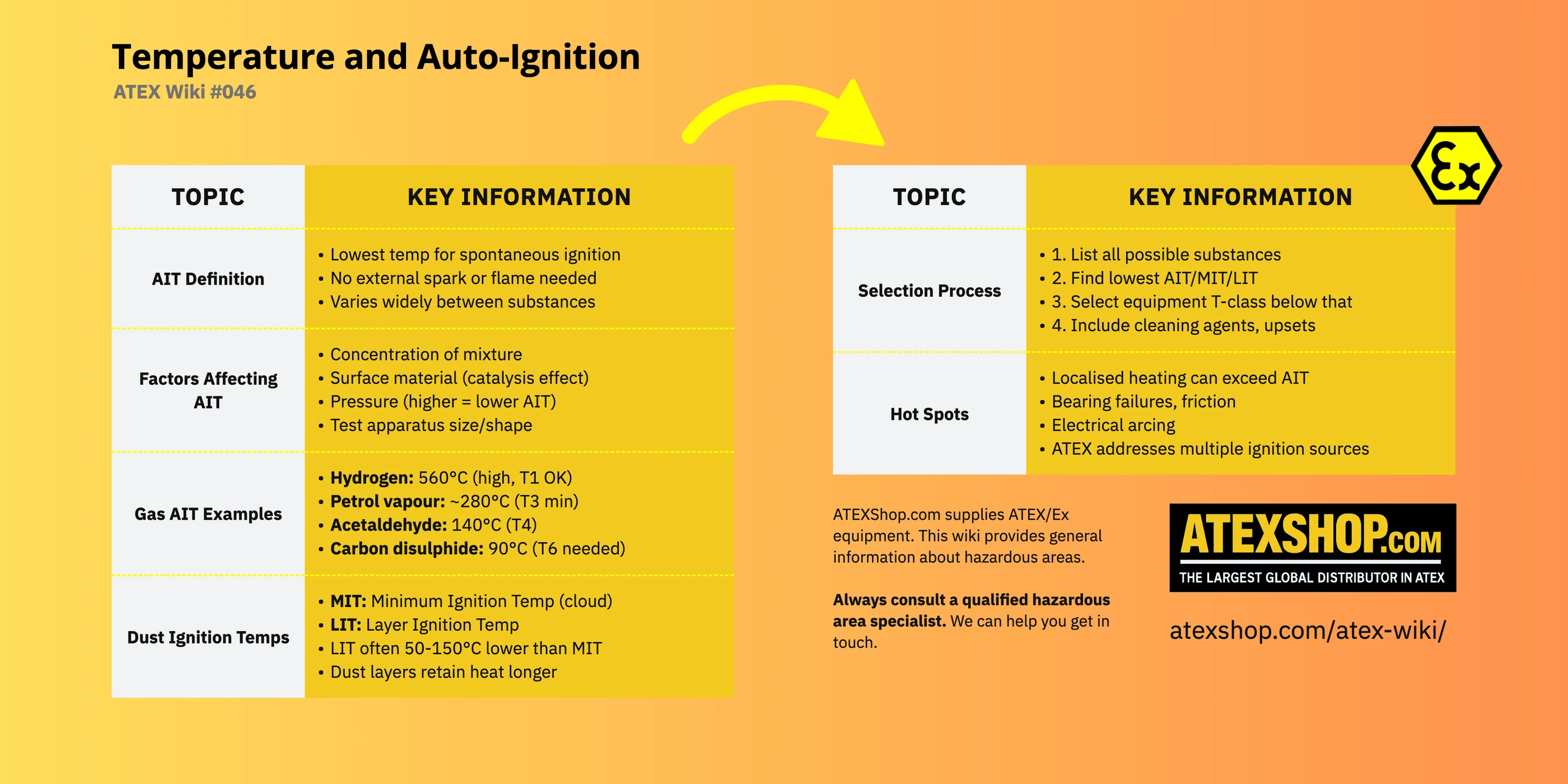
Auto-ignition is the spontaneous ignition of a substance at elevated temperature without any external spark or flame. Understanding auto-ignition temperatures is essential for selecting equipment with appropriate temperature ratings and for assessing ignition risks in explosion hazard analysis.
What is Auto-Ignition Temperature?
The auto-ignition temperature (AIT), also called spontaneous ignition temperature, is the lowest temperature at which a substance will ignite spontaneously in a normal atmosphere without an external source of ignition such as a flame or spark. When a flammable gas, vapour, or dust at or above its AIT contacts oxygen, combustion occurs spontaneously.
IEC 60079-0 defines AIT specifically for explosive atmosphere purposes. Standardised test methods determine AIT under controlled conditions, but actual ignition in industrial settings may occur at different temperatures depending on mixture concentration, contact time, surface properties, and other factors.
Factors Affecting AIT
AIT isn't a fixed physical constant; several factors influence the measured value:
- Concentration: Most flammable mixtures have a concentration at which AIT is lowest; this is usually above stoichiometric
- Surface catalysis: Certain materials (e.g., rusted surfaces) can lower the effective AIT
- Pressure: Higher pressures generally reduce AIT
- Test apparatus: Vessel size and shape affect heat transfer and measured values
Representative Gas and Vapour AITs
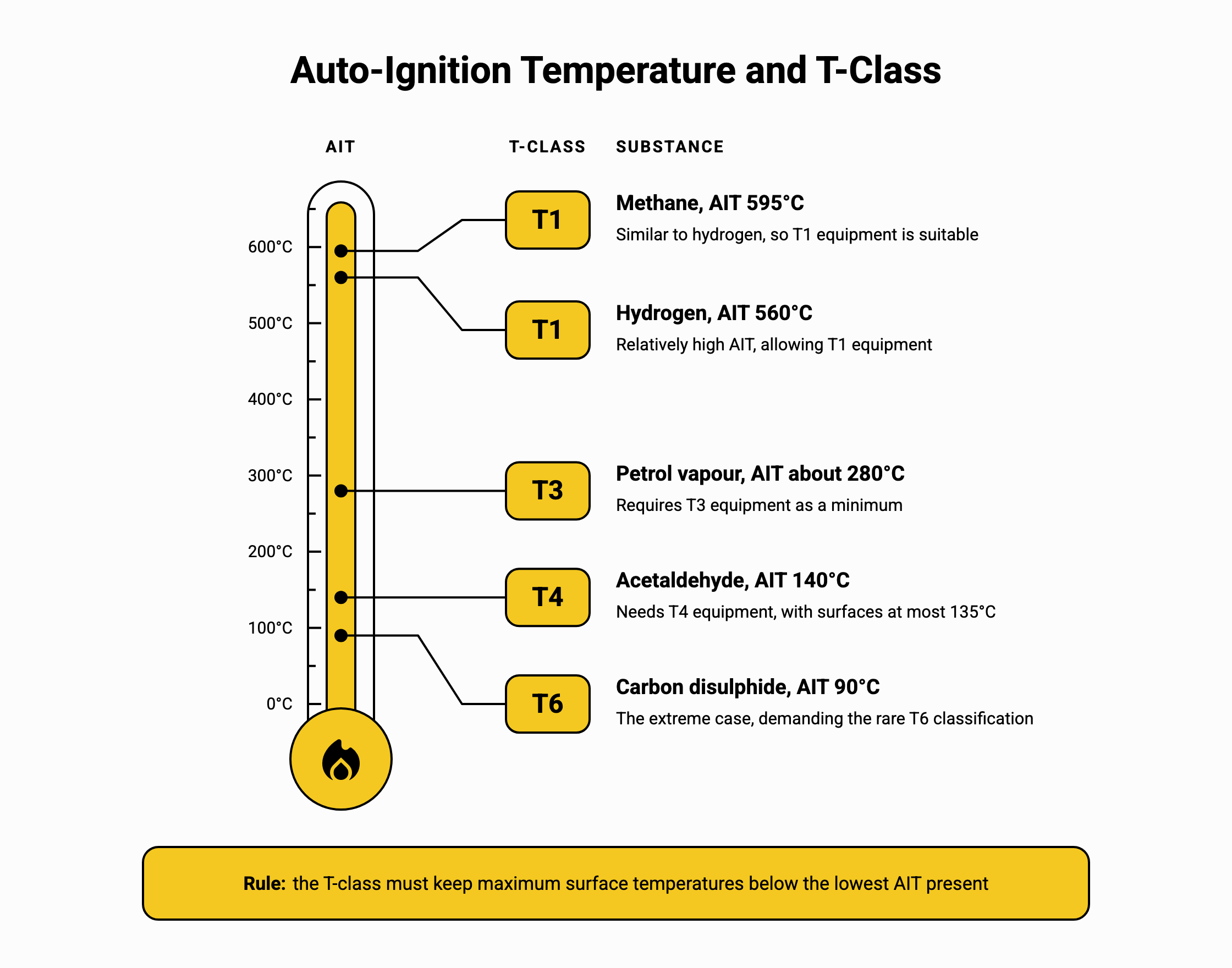
Different substances have widely varying AITs. Some examples demonstrate the range:
Hydrogen has an AIT of 560°C, relatively high, allowing T1 equipment. Methane at 595°C is similar. However, petrol vapour has AIT around 280°C (requiring T3 minimum), while acetaldehyde is 140°C (T4). At the extreme, carbon disulphide has an AIT of just 90°C, demanding the rare T6 classification.
Dust Ignition Temperatures
For combustible dusts, two distinct ignition temperatures apply. The minimum ignition temperature of a dust cloud (MIT) is typically measured in a heated furnace apparatus. Dust layer ignition temperature (LIT) measures when accumulated dust layers ignite, often significantly lower than cloud MIT because layers retain heat and have sustained contact time.
Typical values vary enormously: aluminium powder MIT is around 650°C, while some organic dusts ignite below 300°C. Layer temperatures are often 50-150°C lower than cloud values.
Link to Temperature Class Selection
Equipment temperature classes must ensure maximum surface temperatures stay below the AIT of all substances present. The selection process requires identifying every flammable substance that might be present (including cleaning agents, secondary releases, and process upsets), determining the lowest AIT among those substances, and selecting equipment with a T-class keeping surfaces below that temperature. This applies equally to portable devices carried into the area: an explosion proof mobile phone, for example, needs a T-class that keeps its surfaces below the lowest AIT present.
Safety Margins
Temperature classes provide built-in safety margins: a T4 device (max 135°C) would suit substances with AIT at least somewhat above 135°C. For dust atmospheres, the explicit calculation (max surface = ⅔ of MIT) builds in the margin. However, practitioners sometimes apply additional margins when uncertainty exists about actual substances or operating conditions.
Hot Spots and Localised Heating
Auto-ignition can occur from localised hot spots even when general surface temperatures are acceptable. Friction from failed bearings, electrical arcing inside enclosures, or sparks from mechanical impacts can create brief but intense local heating above AIT. This is why ATEX protection types address multiple ignition sources, not just steady-state surface temperatures.
Ignition Delay
Ignition doesn't occur instantly at AIT; there's an "induction period" or delay. At temperatures just above AIT, ignition may take many seconds. Well above AIT, ignition is rapid. This delay time decreases as temperature increases, but equipment design cannot rely on brief contact times for safety.