
Powder Filling (Ex q)
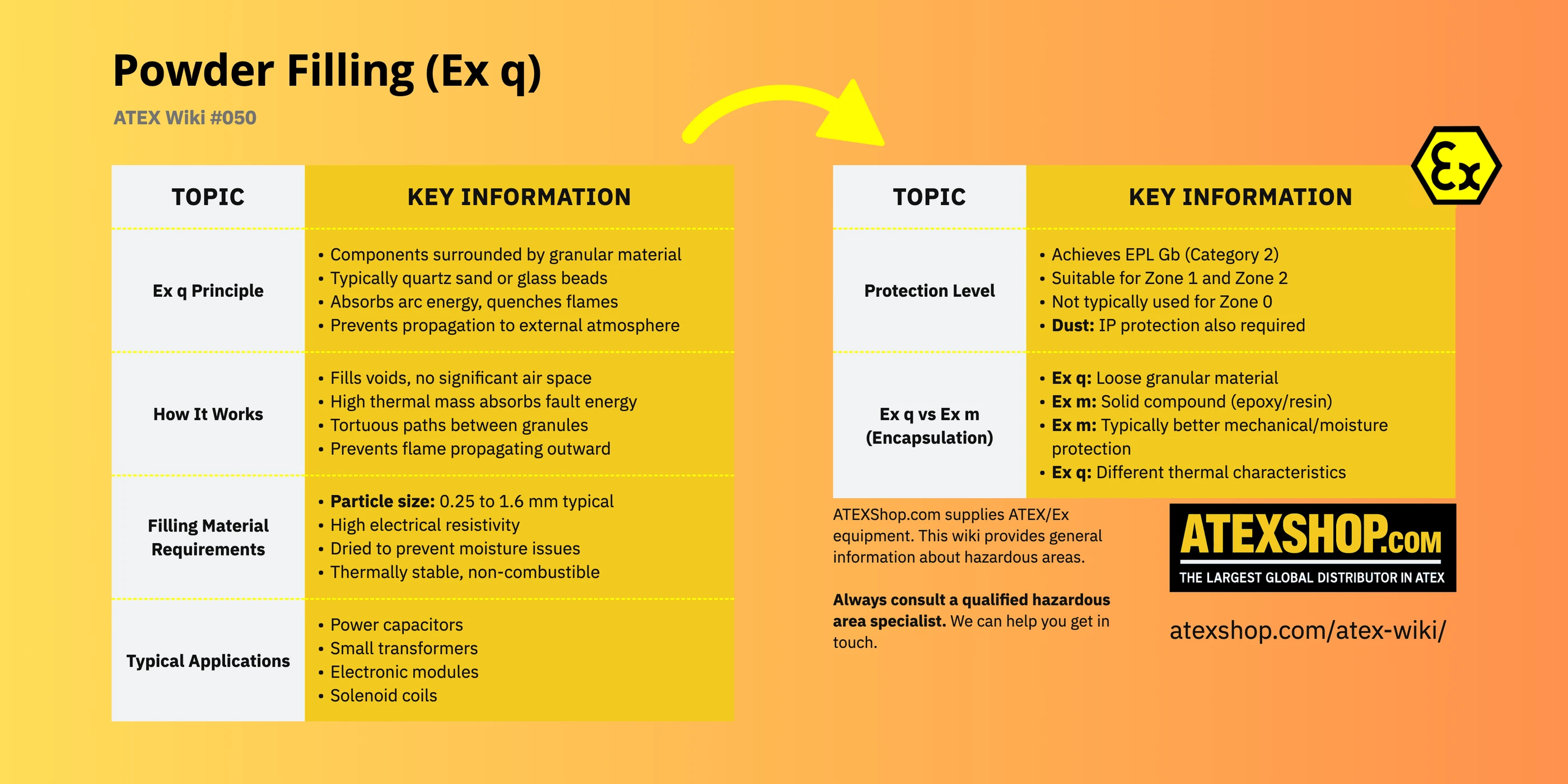
Powder filling, designated "Ex q", is a protection technique where electrical components are surrounded by a mass of finely granulated filling material, typically quartz sand or glass beads. If an arc or spark occurs, the powder absorbs thermal energy, quenches the arc, and prevents flame propagation to the external atmosphere. Defined in IEC 60079-5, Ex q is primarily used for capacitors, small transformers, and electronic assemblies.
The Powder Filling Principle
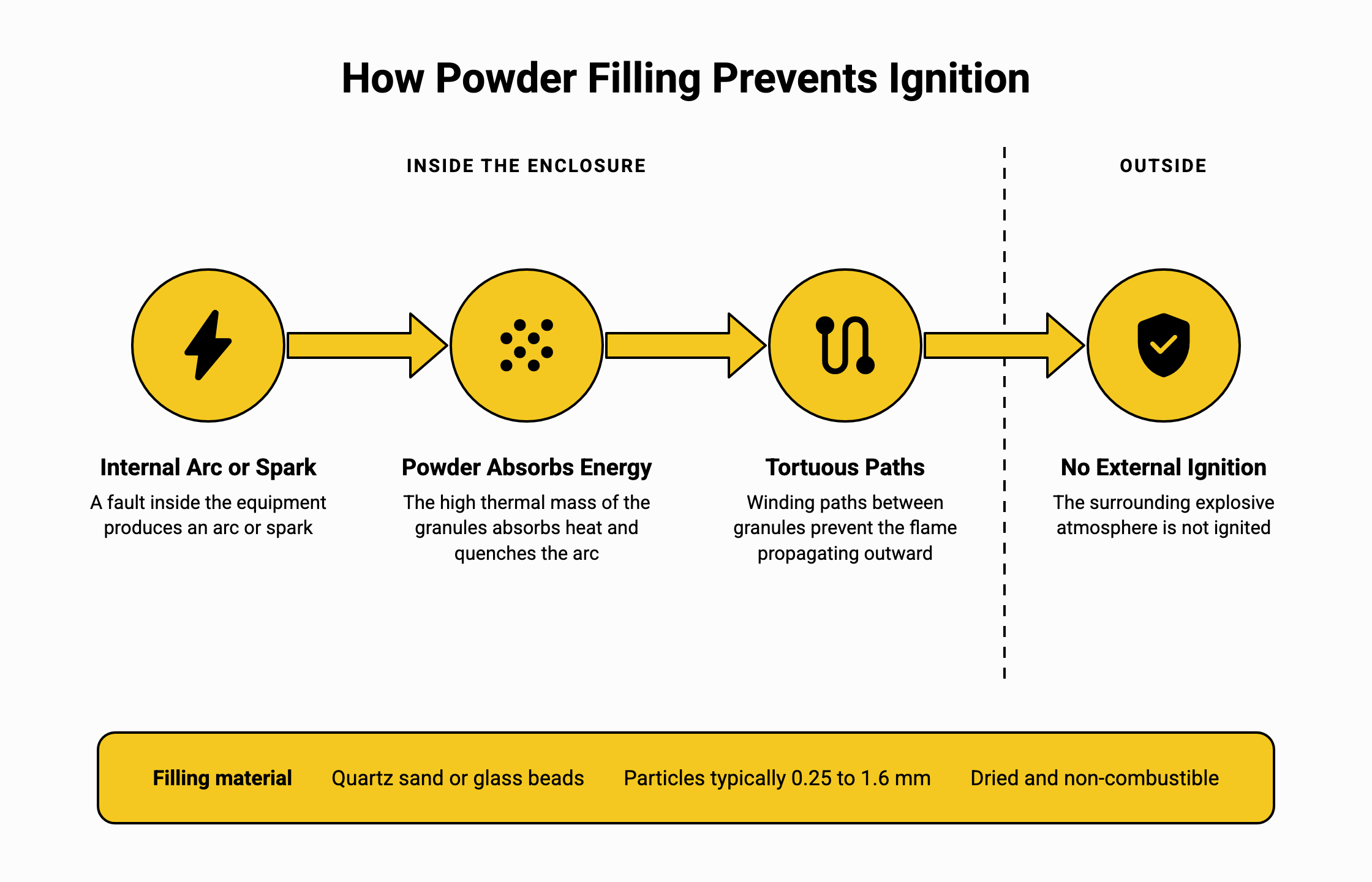
The granular filling material serves multiple protective functions. It fills the voids around electrical components, leaving no significant air spaces where an explosive mixture could accumulate. If an internal fault produces an arc, the powder absorbs thermal energy through its high thermal mass and conducts heat away. The tortuous paths between granules prevent flame propagation outward, similar to how flameproof gaps extinguish flames.
Filling Material Requirements
IEC 60079-5 specifies requirements for the filling material:
- Particle size: Typically 0.25 mm to 1.6 mm diameter for standard applications
- Electrical resistivity: Must be sufficiently high to prevent tracking between conductors
- Moisture content: Must be dried to prevent moisture-related failures
- Thermal stability: Must withstand operating temperatures without degradation
- Non-combustible: Filling material itself must not contribute to fire or explosion
Quartz sand is most commonly used, offering excellent thermal capacity, high electrical resistivity, and wide availability. Glass beads provide similar properties with more uniform particle sizing.
Typical Applications
Ex q suits applications where energy levels are too high for intrinsic safety but components are compact enough for powder filling to be practical:
- Power capacitors: Filter capacitors in power supplies, motor starting capacitors
- Small transformers: Signal transformers, current transformers, voltage transformers
- Electronic modules: Circuit boards and assemblies with higher power levels
- Solenoid coils: Where encapsulation may not be suitable
Equipment Protection Level
Standard Ex q protection achieves EPL Gb, making it suitable for Zone 1 and Zone 2 applications (Category 2). It's not typically used for Zone 0 applications. For dust atmospheres, enclosure ingress protection must prevent dust entry, but the powder filling principle remains applicable.
Design Considerations
Equipment design must account for several factors:
Complete filling: All internal spaces must be filled; voids could accumulate explosive gases. Vibration during handling and transport must not create gaps.
Heat dissipation: While powder absorbs fault energy effectively, continuous heat from normal operation must also be managed. Thermal design ensures surface temperatures remain within limits.
Sealing: The enclosure must prevent powder loss and moisture ingress. Practical designs often include permanently sealed construction with integral cable entries.
Comparison with Encapsulation
Ex q and Ex m (encapsulation) both embed components in protective materials. The key difference: encapsulation uses solid compounds (epoxy, resin) that mechanically bond to components, while powder filling uses loose granular material. Encapsulation typically offers better mechanical protection and moisture resistance; powder filling may be simpler for manufacturing certain component types and allows different thermal characteristics.
Installation and Maintenance
Powder-filled equipment is typically sealed for life; there's no internal maintenance access. Failed units are replaced entirely. Installation is straightforward as the protection is integral to the equipment. The main consideration is ensuring mounting orientation doesn't compromise the filling effectiveness (though well-designed units are orientation-independent).